Married Life for Mary. 3 - Intimacy

Updated: Apr 28
What is intimacy? And what does it look like in married and / or romantic personal relationships? It can mean deep familiarity with a person or in the sense of intimate (noun), a personal or private matter shared with very few, or not shared at all. It can euphemistically refer to a sexual relationship, as in they were intimate, or an emotional one, or both. ‘Intimacy’ advisors work on sets of stage and film to support actors with sexually ‘intimate’ scenes, or can be councillors supporting a person (or couples) with ‘intimacy’ issues around sex and / or emotions. It is a complex concept to define but, as I will argue, one of the best terms to consider when thinking about deep longterm personal relationships. Partly because it is not ‘just’ about sex or supposed romance, but refers to a more emotionally connected feeling. Ideally one that should be at the heart of a relationship and / or marriage.
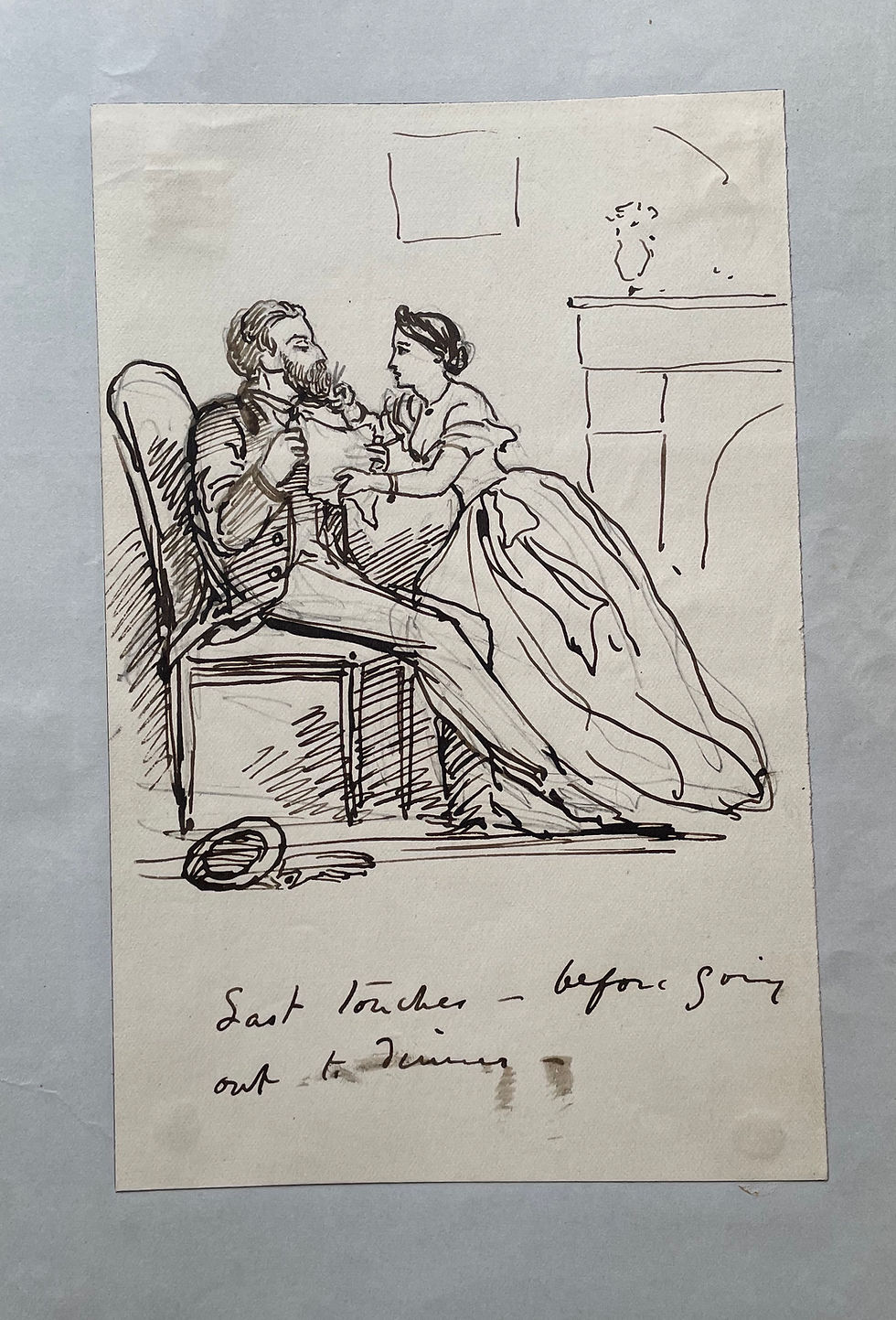
If ‘intimacy’ is difficult to define today, it is even harder when looking back to the 1860s when Ann Mary Severn and Charles Thomas Newton were married. In a previous blog, I described their courtship using Mary’s sketches, which implied deep longing and love. There are no letters or sketches describing their sex life and I wouldn’t expect there to be any. There are sketches, though, that show a deep connection that is sometimes physical, even if it is as simple as cutting a beard.
It is possible to speculate about Mary’s views on love from the poetry she read and on the sexual intimacies of their married life due to societal expectations about sex and pleasure within marriage in their circles at the time. Keats’ The Eve of St Agnes, for example, was one of Mary’s favourite poems and explores sexual passion. Porphyro creeps into Madeleine’s bedroom and watches her undress and haunts her dreams, with longing and potentially consummation:
At these voluptuous accents, he arose
Ethereal, flush'd, and like a throbbing star
Seen mid the sapphire heaven's deep repose;
Into her dream he melted, as the rose
Blendeth its odour with the violet,—
Solution sweet: meantime the frost-wind blows
Like Love's alarum pattering the sharp sleet
Against the window-panes; St. Agnes' moon hath set.
Take Tennyson, another of Mary’s favourite poets (and mine as a teenager), in this early poem from the 1830s where the words are licked with sensuality:
O beauty, passing beauty! Sweetest sweet!
How can thou let me waste my youth in sighs?
I only ask to sit beside thy feet.
Thou knowest I dare not look into thine eyes.
Might I but kiss thy hand! I dare not fold
My arms about thee—scarcely dare to speak.
And nothing seems to me so wild and bold,
As with one kiss to touch thy blessed cheek.
Methinks if I should kiss thee, no control
Within the thrilling brain could keep afloat
The subtle spirit. Even while I spoke,
The bare word "kiss" hath made my inner soul
To tremble like a lute string, ere the note
Hath melted in the silence that it broke.
Tennyson's poem owes much to Sappho. This is not to be sensationalist (if there were more sensation, I may have been able to sell a book on Mary by now!). It is deeply important to having a sense of how a couple may have lived together and intimacy is key, as Melissa Febos has argued:
That these topics of the body, the emotional interior, the domestic, the sexual, and the relational are all undervalued in intellectual literary terms, and are all associated with the female spheres of being, is not a co-incidence (10).
Mary’s favourite poets spoke of desire and pleasure, admittedly sometimes in a weird and creepy melancholy way. (Note to self, may it wasn’t just the Brontes to blame for my disastrous lovesick teens).
Victorian Sexual Pleasure
Yes, yes and ohhhh yes, people enjoyed sex in the Victorian period. This should not be a new premise as it has been argued by historians such as Matthew Sweet and Fern Riddell for decades now. Michael Mason showed In The Making of Victorian Sexuality in 1995 that, though there were shifts in thinking and behaviour through the nineteenth century, most people through the century believed that a woman was more likely to conceive if she climaxed (or orgasmed) during sex. There was even a court case that discussed woman’s sexual response and pleasure of orgasm in some depth (1888 Casey v Imlach) due to an operation on Mrs Casey’s ovaries that she argued had damaged her ability to orgasm. This impacted her married life as well as her ability to conceive children.
The doctor and expert on masturbation, William Acton made a notorious remark that women ‘are not troubled with much sexual feeling of any kind’ in 1857 and this has often been taken to be the Victorian medical view on women and sex, even the Victorian view on sex. Yet, Acton revised his opinion and his comment was atypical. Even today, the false idea that women need to feel pleasure to conceive can overshadow rape cases where a pregnancy has occurred. There were also manuals, such as Aristotle’s Masterpiece, which were passed down from and between women as a kind of ‘secret knowledge’. These manuals were not accurate on conception and issues in pregnancy but not entirely false either. Again, the emphasis was on pleasure, not just logistics in sex.
Why is any of this important to understanding Mary’s marriage? The point here is that, given the circles of writers and artists she moved in, she would have been likely to have some knowledge of sex and its mechanics, plus an idea of its pleasures. If her family were speculating about why she was not pregnant and implying her husband was driving her too hard work wise, that meant an implication that she was not happy sexually either. There is no evidence of that from what I have seen and read. When Walter Munby goes to visit Mary and Charles at their house in 37 Gower Street, shortly after they married, he writes that:
Here live Newton and his bride Mary Severn, settled in a fine substantial old house, with a garden and rookery behind. She looked well and happy; and he too, as well he might.
There is also a question, which had not occurred to me before, that may be Mary did not want children? Or at least, did not want to be like her older sister Claudia Gale, who was almost constantly pregnant and ill from the time of her first baby in 1853. Claudia had four daughters and one son, plus at least one baby who died. On 20 May 1863, Mary wrote to her younger sister Eleanor that she was godmother at her new nephew’s (Horace) christening where ‘all the little Gales were in scarlet cloaks and a feast.’ There was:
. . .great confusion. I do not know how Claudia stands it and she is very ill. The Goddard child is very spoilt. I wish she would go to a warmer clime.
Claudia died in 1874, eight years after Mary, when she was 45 years old but she had not been well for at least 15 years, due, in large part, to her continual pregnancies.
Burnt Letters
Considering the intimate side of Mary and Charles’ married life can only be speculative and no doubt, in their all too short time together, emotions moved, deepened and evolved. There were many more letters between Mary and Charles, but they were burnt by Mary’s Gale great nieces. In 1932 Lady Sheila Birkenhead, author of the most extant biographies of Mary in her books on Joseph and Arthur Severn, spent an afternoon with Dr T. Wilson Parry, a doctor, geologist and Keats’ fan. She clearly expressed her annoyance at lending letters from her mother in law’s collection to her cousins (second cousins?) as they burnt them rather than returned them:, to which Parry replied:
I do hope you will very seriously consider the collecting and marshalling of Mary Severn's works. Reproductions of them and the many items in trust you have of her life would make pleasing reading. I feel a burning indication against those 'Gale women' for their wilful incendiarism!
Why were they burnt? Too racy? Possibly. Critical of Frederick Gale? Perhaps. Unfortunately, we’ll never know.
For a glimpse of marital intimacy, I believe we should look at Mary’s work. This sketch of Charles asleep (in the Department of Greece and Rome, British Museum) shows a tenderness that wraps up the love of pragma (practical love in marriage), the affection of storge (familial love) and, I believe, the passionate limb loosener of eros (erotic love) too. The Ancient Greeks had many words for love as love is complex and changeable. No words or images can truly capture it but it does help whan we have those words and they are not burnt.

References
Melisa Febos (2022), Body Work. The Radical Power of Personal Narrative
Michael Mason (1995), The Making of Victorian Sexuality
Fern Riddell (2014), The Victorian Guide to Sex. Desire and Deviance in the Nineteenth Century
Matthew Sweet (2001), Inventing the Victorians


