The Art Blockbuster: The Greek Miracle. Classical Sculpture from the Dawn of Democracy. The Fifth Century BC

Introduction

The exhibition The Greek Miracle. Classical Sculpture from the Dawn of Democracy. The Fifth Century BC was displayed at the National Gallery of America in Washington DC from 22 November 1992 to 7 February 1993 and then at the Metropolitan Museum of Art in New York from 11 March to 23 May 1993. The exhibition marked the 2,500th anniversary of Kleisthenes’ reforms of the Athenian constitution in 507/8 BCE, which, it is argued, marked a change in political practice and led to democracy in Athens. The Greek Miracle at these two American venues displayed art from the time of Kleisthenes’ reforms to the late fifth century BCE to illustrate how art in Athens (and to some extent Greece in general) developed over this century. The exhibition continued the story of Greek art through the Greek classical style from the development of archaic art through to early classical style that had been displayed in The Human Figure in Early Greek Art exhibition that had been held at the National Gallery of Art in 1988. This earlier exhibition had then toured several other venues in America until September 1989.
The two American venues hosting the show are defined as art museums, though the Metropolitan has a large and significant archaeological collection, and the objects were aesthetically displayed as art objects. It was the first time that Greece had ever loaned many of its most important objects to an international exhibition and the exhibition also included loans from the British Museum in London, the Musée du Louvre in Paris and other European museums. The exhibition was significant for a number of reasons: it was a major ‘blockbuster’ of classical art for a broad general public; it included a huge international loan from Greece (which also entailed the loan of major art works from the two American venues to the National Gallery in Athens); the visual marking of the ‘birth of democracy’ through an art exhibition; the publicity around the exhibition and its announcement; the political involvement of the Prime Minister in Greece and President of the United States; the timing of the exhibition in 1992-3; and the critical controversy (and indeed hostility) that the exhibition caused.
The Lenders
Every object chosen presents a choice on the part of the curator (or curatorial team), lending institutions and hosting venues. Therefore, it is important to consider what was displayed, from where and why certain ‘key’ objects were chosen for The Greek Miracle. Classical Sculpture from the Dawn of Democracy. The Fifth Century BC.
The objects came from a great number of institutions in Greece and the rest of Europe as well as from the Metropolitan Museum of Art in New York itself. The institutions that lent objects to the exhibition from within Greece were the Acropolis Museum, Athens; Agora Museum, Athens; Archaeological Museum, Eleusis; Archaeological Museum, Samos; Kerameikos Museum, Athens and the National Archaeological Museum, Athens. Other institutional lenders were the British Museum, London; the Metropolitan Museum of Art, New York; Musée du Louvre, Paris; Musei Capitolini e Monumenti Communali, Rome, Staatliche Antikensammlungen und Glyptothek, Munich and Staatliche Museen zu Berlin, Antikensammlung. The great number of lending institutions and particularly those from Greece was heralded as a coup when the exhibition was announced, though there were serious misgivings within the archaeological community and leftwing political groups in Greece. The number of loans from European museums was used as a selling point by the institutions marketing the exhibition and even by reviewers who were otherwise hostile to the exhibition. For example, in a review for The New York Times, Holland Cotter wrote that:
the one truly democratic feature of The Greek Miracle is that it brings this work to viewers who may never be able to hop on a plane to Europe.

One of the objects lent that caused most controversy in Greece was slab XXXI from the North Frieze of the Parthenon, which was housed in the Acropolis Museum, Athens. The controversy over the international loan of this frieze block was due to the dispute between the Greek government and the British Museum over the legality – and the ethics – of the acquisition of the sculptures from the Parthenon and elsewhere on the Acropolis by Lord Elgin in the 1800s, as well as the British Museum’s acquisition and continued retention of the ‘Elgin Collection’. The Parthenon sculptures have long been considered the artistic exemplars of Periclean Athens at the height of democracy and imperial power as well as key examples of Greek art in the ‘high classical’ style. The Parthenon sculptures owned by the British Museum were conspicuous by their absence as the legality of their retention may be threatened legally if they left Britain – as in fact happened in a loan of nineteenth-century aboriginal bark drawings from the British Museum to a major exhibition at the Victoria Museum in Melbourne, Australia in 2004. Jerry Theodorou, reviewing the exhibition for Minerva, commented that the furore created would be ‘totally out of place in the context of a birthday party for Greek democracy’. Arguably the debate around the issue would be totally in context for the values and celebration of Greek democracy. One of the legacies of this exhibition was the renewed campaign for the restitution of the ‘Elgin collection’ from London to Athens.
Although there were a great deal of museums involved in lending objects, the number of objects in the exhibition was fairly small. Only 34 antiquities were on display at The Greek Miracle in Washington in total. This was partly due to the decision to just exhibit original objects from fifth-century Greece rather than Roman copies of original Greek sculptures such as, for example, the copy of Harmodious and Aristogeiton on display at the Archaeological Museum in Naples. The then Director of the National Gallery of Art, Earl A. Powell III and the Director of the Metropolitan Museum of Art, Philippe de Montebello wrote in the foreword to the catalogue of the exhibition:
While a more complete story of fifth-century art could be told be including later Roman copies of lost originals, Roman copies do not convey the subtlety and magnificence of the of the Greek prototypes; above all, they lack that inner life we sense in the original works.
This emphasis on the authenticity of the sculptures in both aesthetic and ideological terms is not new. It dates back to the first display of the sculptures from the Parthenon and elsewhere on the Athenian Acropolis in London in the 1800s (and arguably to the writings of Johann Joachim Winckelmann before that). However, this emphasis is important for this exhibition as it presents classical art developing at the same time as and being influenced by the development of democracy. Therefore, copies would not hold the ‘inner life’ of the political and philosophical character of Athenian Greeks from the Fifth Century BCE. Despite this emphasis, some of the sculptures on display were not in fact from classical Athens but from elsewhere in Greece, such as the metope from the Temple of Zeus in Olympia in the Peloponnese. Arguably the combination of archaeological locations did not matter since artists travelled across classical Greece in search of commissions and so there would have been an exchange of creative techniques and ideas – though this point is not made in the exhibition catalogue. The two directors stress the importance of ‘Greek prototypes’ as they were the prototypes for the traditions of later western art.
Objects
It is worth drawing attention to some of the key objects exhibited and considering why they are so significant to the story of art and democracy narrated through the exhibition. These objects also contributed to the critical reception of the exhibition in reviews and analysis.
Number 1 in the catalogue and the first object seen on entering the exhibition, being displayed in its own vestibule, was the marble ‘Statue of Youth: Kouros’ dating from 530-520 BCE. This kouros had been found in the Sanctuary of Apollo on Mount Ptoön in Boeotia and is now in the National Archaeological Museum, Athens. The sculpture was used in the exhibition to represent the late Archaic style of Greek art and to signify similar kouroi found on the Acropolis and elsewhere in Greece from that time. Kouroi are freestanding sculptures of young men – the feminine form is korai – who were possibly used as votive offerings. It also illustrated the ‘increasingly naturalistic way’ of representing the human body and the ‘developed musculature and vigorous energy of the figure place it close to the end of the century’. This kouros had previously been displayed in the exhibition The Human Figure in Early Greek Art in 1988-89, where it was displayed towards the end of the exhibition and was singled out for showing a ‘notable change’ from earlier sculpture in the ‘treatment of the head’. In this way the two exhibitions are connected: The Greek Miracle begins where The Human Figure finishes.

The star of the show was undoubtedly catalogue number 5, the marble ‘Statue of a Youth: The Kritios Boy’ (c. 500-480 BCE), which had been found (in parts) on the Athenian Acropolis and is now in the Acropolis Museum. The sculpture ‘marks a dramatic break from the canon’ and was positioned behind the earlier Kouros in the exhibition at Washington DC so that the change in the more naturalistic depiction of body can be clearly seen. This use of comparison between the earlier and later sculptures was a common motif in art historical analyses of Greek art. In 1959 E. H. Gombrich used a kouros from 600 BCE (Apollo of Tenea) and one from about 500 BCE (Apollo of Piombino) to contrast with the Kritios Boy from c.480 BCE in ‘Reflections on the Greek Revolution’ in Art and Illusion. Gombrich commented that the Kritios Boy breaks ‘the symmetry’ of the tense posture of earlier kouroi ‘so that life seems to enter the marble’.

J. J. Pollitt, who contributes an essay to The Greek Miracle catalogue, similarly contrasts an early kouros with the Kritios Boy in his book Art and Experience in Classical Greece (1972). Even if the Kritios Boy is not contrasted to earlier Greek sculptures, the sculpture plays a part in any survey of Greek art, such as John Boardman’s Greek Art, and acts as an example of the early classical style of Greek sculpture. The Kritios Boy is purportedly made by a sculptor called Kritios, though this attribution is due to the fact that the head has similarities with the head of Harmodius from the Tyrannicide group by Kritios and Nesiotes. However tenuous the connection between sculptor and sculpture, a named piece fits more readily into the western art tradition of emphasising the individual creator of an art work. Perhaps most significantly, the artistic innovations seen in the Kritios Boy are taken to physically embody the developing democratic politics of Athens, as J. J. Pollitt comments in an essay in the exhibition catalogue:
Critics have seen this figure as perhaps the first sculptural image designed to express the new sense of individual responsibility that grew out of the Kleisthenean reforms and the Persian challenge.
In this way, it is inferred that artistic developments in Athens reflect political changes and the growth of democracy. Curiously, no mention is made of the possible erotic significance of this sculpted adolescent kouros, nor of its iconography in the body politics of Athens. The Kritios Boy embodied the ‘values’ of the exhibition and was used in the marketing of the exhibition and was often the key image reproduced or referred to in reviews.

Catalogue number 9 ‘Herakles Receiving the Golden Apples of the Hesperides’ dating from c.460 BCE is another sculpture that reflects the stylistic changes and expressions of the early classical style. The metope comprising the three figures of Herakles, Athene and Atlas is from the Temple of Zeus at Olympia and is presented as an example of architectural sculpture. This metope is one of several sculptures which do not come from democratic Athens but is included in the exhibition nevertheless. Arguably, the Temple of Zeus at Olympia and the art work belong to a different function in Greek art and archaeology from that of classical Athens, as well as a very different political climate.

Catalogue Number 10 the bronze ‘Head of a Youth or God: The Chatsworth Apollo’ dating from 460-450 BCE is an example of one of several heads of sculptures displayed in The Greek Miracle. The bodies of the sculptures may have been lost but heads are used to depict the ‘severe’ facial expression of the early classical style and the change from the serene archaic smile. This head is also the only object lent by the British Museum and was originally found in Cyprus in 1836, becoming part of the ‘Chatsworth collection’ before being acquired by the museum. The inclusion of a loan from the British Museum is significant given the objects that were not loaned from the museum: namely the sculptures from the Elgin Collection.
Catalogue number 22 ‘Calvary from the Parthenon Frieze’ (see above) dating from 442-438 BCE is one of the most significant objects in the exhibition because it is a frieze block (Slab XXXI from the North Frieze) from the Parthenon and dates from the height of Periclean democracy (Illustration 8). The Parthenon frieze is important in the story of democracy in Athens not just due to the dating of the pieces to the refurbishment of the Acropolis orchestrated by Pericles after the democratic reforms of the 460s BCE. It is also an example of an artwork, whose creation was overseen by Pheidias and is traditionally positioned within the ‘high classical’ style. The frieze is also considered by many scholars to depict the important Athenian festival of the Panathenian, when a new peplos was presented to the goddess Athene and the whole city took part in a procession to the Acropolis. The frieze, therefore, is not only an example of the high style of classical art composed at the height of Athenian democracy but is also believed to represent the city of Athens and its citizens.
The exhibition displayed many grave stelei due to their artistic rendition and as a way of depicting individuals from ancient Greece. Catalogue number 28 ‘Grave Stele of a Little Girl’ dating from 450-440 BCE is a rare example of an object from an American museum, namely the Metropolitan Museum of Art. Although more objects from the Met were added in the display in the Met itself at New York. This attracted some comment from American reviewers as the Met’s collection was said to ‘hold its own’, though Beryl Barr-Sharrar commented that ‘it is to be hoped’ that American museums would collect more works from fifth century Greece.
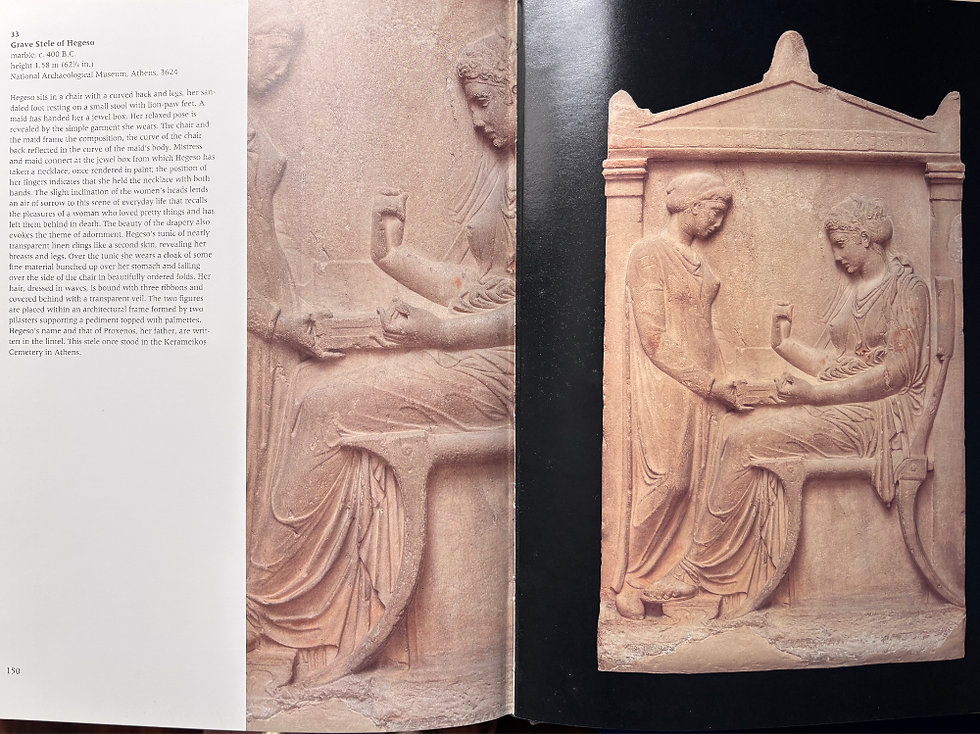
The depiction of a child on a stele from Paros adds a sense of individual portraiture of ancient Greeks to the exhibition, which is continued in ‘Grave Stele of Hegeso’ (catalogue number 33) dating from c. 400 BCE. The inclusion of the name of the female central figure and that of her father (Proxenos) within the lintel gives a personal history to this object as well as being an example of an Athenian stele that originally stood in the Kerameikos Cemetery in Athens. Although the name of the woman and her father is known, it would only be by being a daughter, wife and mother that she would play a part in Athenian democracy – though the catalogue does not mention this.
Hegeso is also pictured being attended by a female slave and again no mention is made of the identity of this person or of their enslavement in democratic Athens.
The emphasis in The Greek Miracle is on sculpture, whether in marble or bronze. There were no red or black figure vases listed in the exhibition catalogue, which seems a curious omission given the red figure technique was developed in the early fifth century in Athens. Red-figure vase painting is arguably more uniquely Athenian and representative of Athenian society than sculpture. The objects alone signify that the exhibition had a traditional art historical setting with little archaeological context or social history.