Married Life for Mary. 1. The (normally) unseen work of housekeeping

In August 1854, Mary Severn had taken her younger sister Eleanor to Margate to stay for a holiday near her client the Marriotts – later friends too – and a much-needed break. London Society closed in August and most people went back to their estates or country houses, whilst those a little further down the class rank went to their houses by the sea, such as in fashionable places like Llandudno, or to hotels and, in Mary’s case, boarding houses. Mary went to make Mrs Marriott’s portrait and do a few other portraits of middleclass wives and children while they were on their holidays. Mary always wrote down how much ‘tin’ she received for each ‘com’ and dutifully told her mother Elizabeth:
You will be astonished when I tell you that I am going to ask you for more tin, as I have this additional week to pay. I have written down every penny I have spent at the time & it all balances, how money does go!!!
Mary Severn to Elizabeth Severn, August 1854, Margate
Elizabeth was in firmly charge of the household finances and Mary was contributing to them, if not the sole contributor (from work at least, as Elizabeth’s family made gifts of money). Mary had little time to get on top of household budgets, despite the amount of time she was often left in charge of the London house overseeing the main family servant, as well as an occasional cook and servant. By 1858, this situation had changed again as Walter moved back in with the family into a larger house and, of all the family, Mary’s elder brother was the most savvy with money, or ‘tin’.
When Mary married in 1861, she was catapulted into a new situation – managing the household of 37 Gower Street. This meant being in charge of the money, bills, servants, keys, dinner (when and what to eat), services (delivery of coal and food) - though this would ordinarily be delegated to a housekeeper if they had one:
Once married, a middle-class woman was expected to run her household, directing the servant or servants, and managing the budget through detailed planning and account keeping. (Steinbach 2004, 71).
Mary draws numerous sketches of her inability to look after the bills. In one she uses a Greek vase and her drawing of it to distract her husband Charles from looking at the weekly bills.

In another, she shows her despair at not being able to make the balance come right while a caricature if Newton is on the easel.

Mary poked fun at her inability to be able to make the balance come right but was also very aware – perhaps depressed – about her shortcomings as a domestic housekeeper. Given her family background of living from week to week, escaping creditors and having numerous members of the family come and go with commissions and rarely a salary – her brother Walter was an exception – it is unsurprising that she struggled. There was a stability and set of expectations that she was not used to.
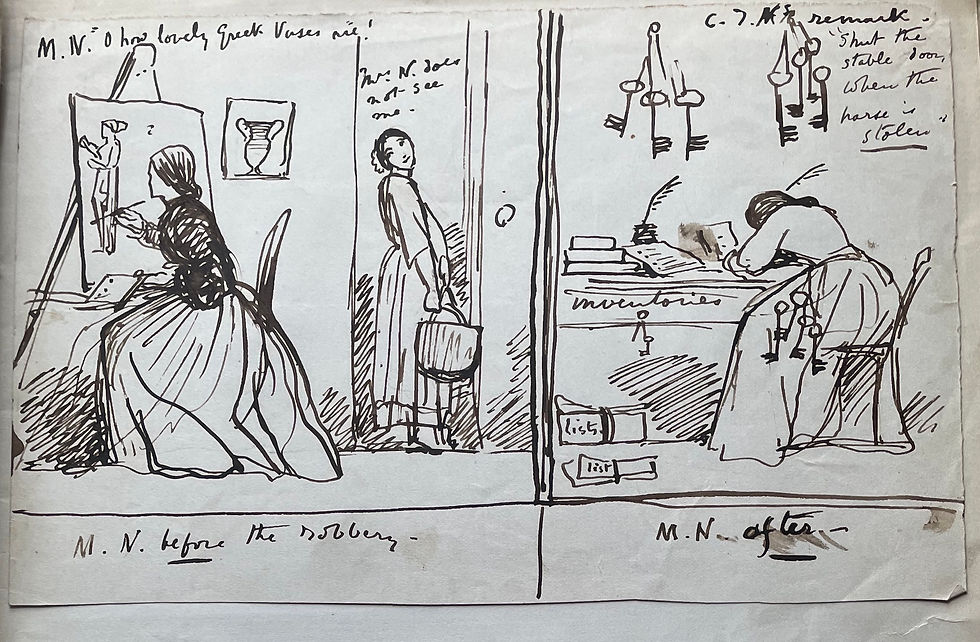
She had generally also lived with one loyal servant and an occasional cook with house girls that came and went to do the scullery chores, as is attested from letters to her mother. In her new house, it seems that she had at least a cook / housekeeper and live in domestic servant. At some point in their married life, a theft occurred at their house in Gower Street and Mary makes two sketches of her showing the before and after. She is intent on her art work and a book is on the floor before the theft occurred and then dedicated to the keys and inventories of plate afterwards.

Again, given her experience of hiding items from creditors – mainly books and art materials, not ‘plate’ – Mary would have been unlikely to have precious possessions that were locked away in the Severn family household. The theft – from the drawings of a household servant’s bedroom being searched – appear to have been by a live in maid.

Given Mary’s trusting nature was remarked upon by all who knew her, it is this as much as her dedication to work that made the thefts likely. Mary had two jobs in her married life – artist and mistress of a household – and struggled to do both, though arguably had stability and freedom from creditors in a manner she had not had in the Severn family home. Mary was not a domestic ‘Angel in the House’, but then Coventry Patmore’s poem* only has an epilogue for the marriage of his ‘ideal wife’. As Jane Eyre points out to Mr Rochester, with authorial irony, six months is the length that male authors give to a husband’s matrimonial ardour, no doubt as things like bills, washing, and the (gloriously) abject realities of sex undermine the poetry of ‘loves’ bright arrows’. What these sketches do is give an insight into the reality of marriage for a working woman passionate about her profession.
*Genuinely one of the dullest poems I’ve ever read. Boring Honoraria married the equally boring and creepier Felix. But then, it is fair to say I have no desire to be a ‘rose’, a ‘queen’, or any other romantic epithet used to ultimately control me. I read this long poem about the very boring courtship urging the poor woman to run away.
Steinbach, Susie (2004), Women in England 1760-1914: A Social History.